What Web Developers Actually Do
The movies show a developer typing fast in a dark room. The real job is mostly understanding, reading, and checking. Here is what frontend, backend, and full-stack developers spend their days on, and where AI fits in.
Ask someone to picture a web developer and they'll describe the movie version: headphones on, green text flying up a black screen, a product appearing by morning.
Then you get your first real task. It's one sentence long, something like "the save button sometimes doesn't work." You spend an hour reading code someone else wrote, twenty minutes figuring out how to make the bug happen on purpose, and ten minutes changing three lines. Then a teammate asks why you chose those three lines.
That is the job. This lesson is about what fills a developer's day, how the work splits into frontend and backend, and why AI makes the judgment part more important, not less.
Code is the tip of the iceberg
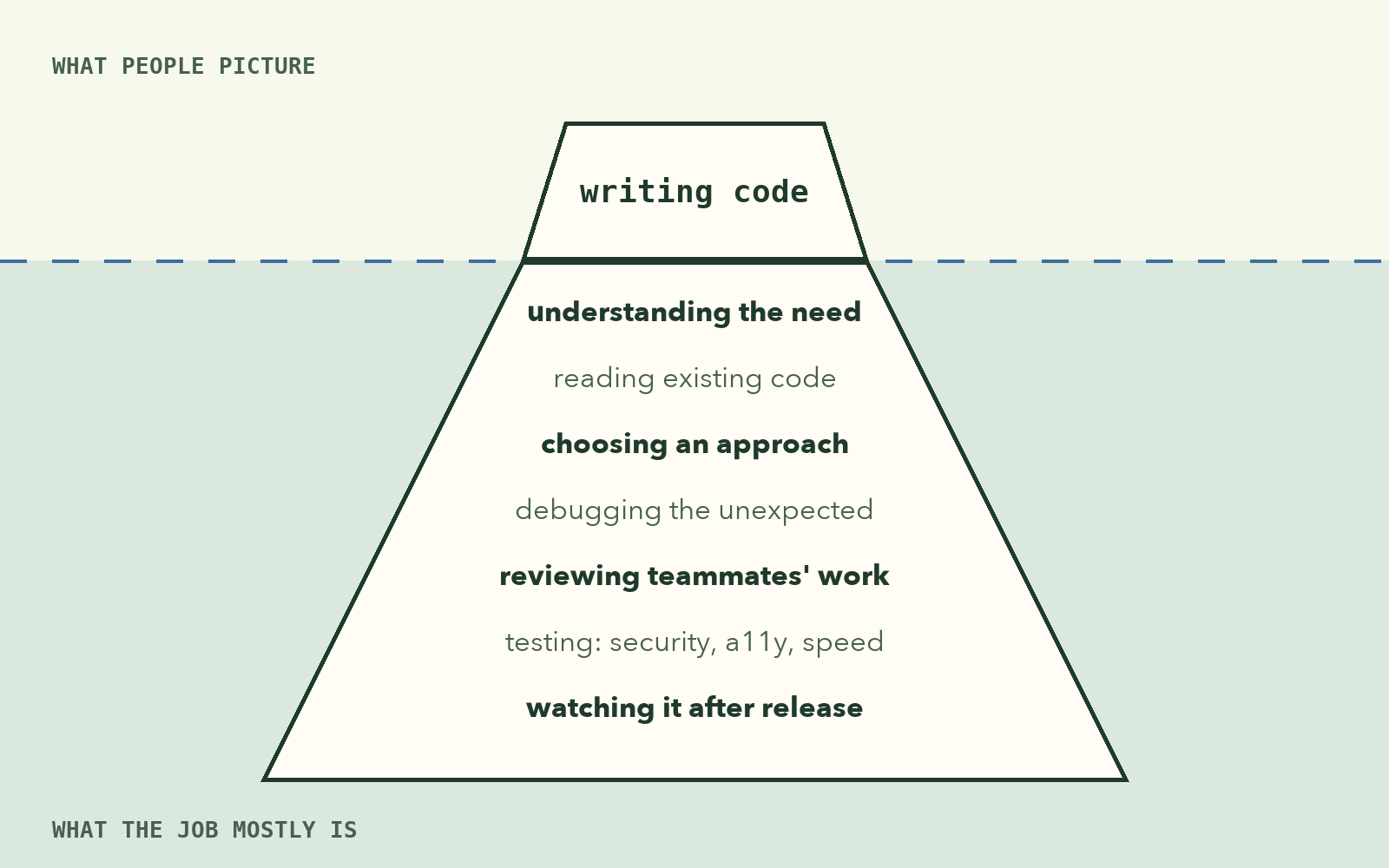
Writing code is the part people can see. It's also the smallest part.
A normal week includes things like:
- Understanding the need. What does the user actually want? Often it's not what the ticket says.
- Reading code. Most work happens in code that already exists. You read far more than you write.
- Choosing an approach, and explaining the trade-offs to people who'll live with it.
- Debugging behavior nobody expected.
- Reviewing teammates' changes, and having yours reviewed.
- Testing for security, accessibility, speed, and what happens when things fail.
- Watching it after release, because real users find problems no test did.
The balance changes with the job. Someone building a new prototype might type code most of the day. Someone looking after a big, old system might spend most of it investigating and coordinating. Either way, the goal is the same: turn a need into software that keeps working once real people use it.
Frontend, backend, and the person who does both
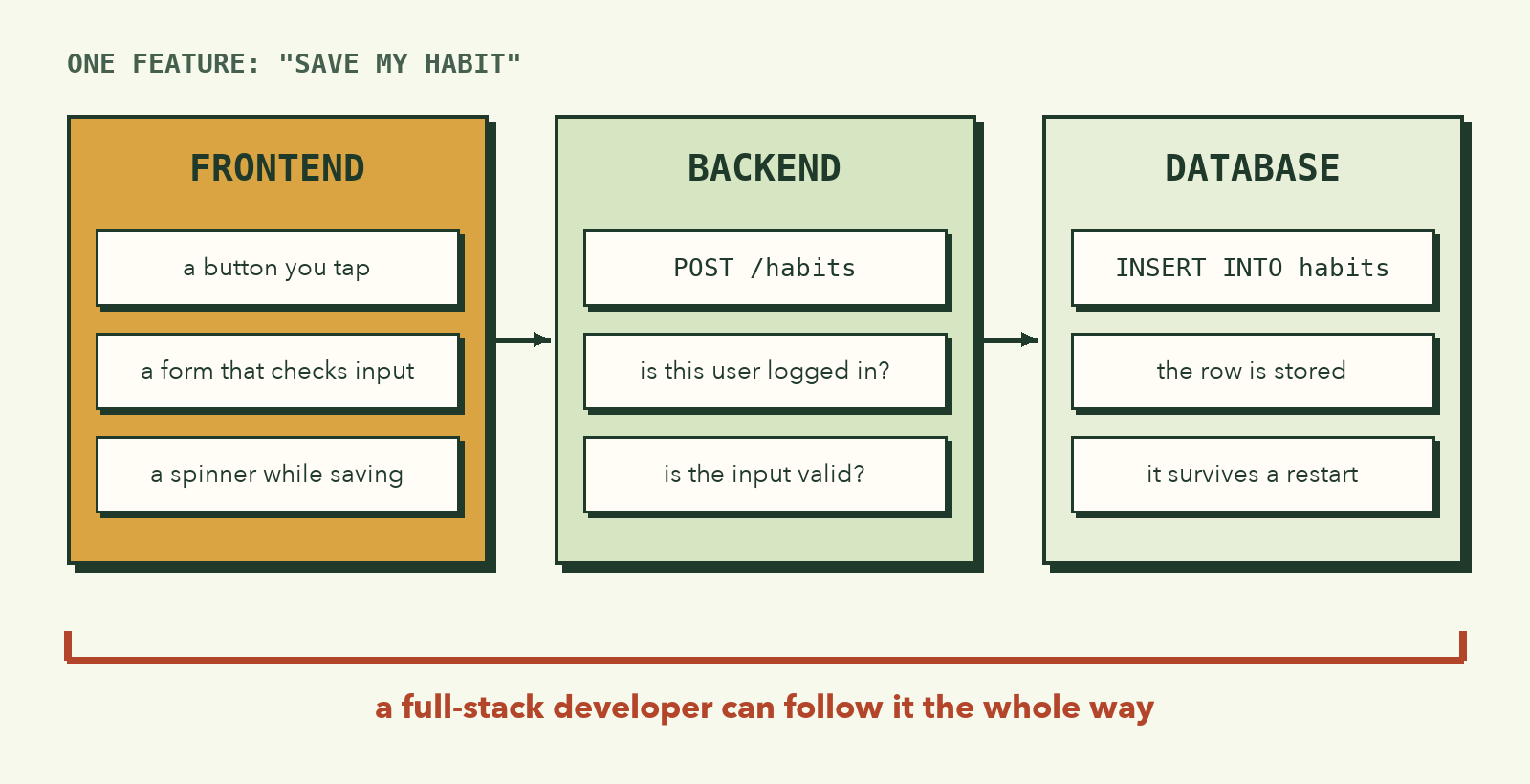
Take one small feature: a habit-tracker app where you tap Save and your habit is stored. Follow it from your thumb to the database and it passes through three layers.
Frontend: what people see and touch
A frontend developer builds the part that runs in the browser: the button, the form that complains when you leave a field empty, the spinner while it saves. The work is layouts that fit any screen, accessible controls, smooth interaction, and pages that load fast on a cheap phone.
The usual tools are HTML, CSS, and JavaScript (or TypeScript), often with a framework like React, Next.js, or Vue.
Backend: the rules and the memory
A backend developer builds what happens after the request leaves the browser. Is this user logged in? Is the input valid? Where does the data go, and who's allowed to read it later? The work includes APIs, authentication, databases, background jobs, and keeping it all running.
Security lives here too. One example: passwords must be stored with one-way hashing, never in a form that can be turned back into the original. OWASP's password storage guide explains why.
Common tools are Node.js, Python, Go, or Java, plus SQL databases like PostgreSQL and caches like Redis.
Full-stack: following the feature the whole way
A full-stack developer can follow that feature across every layer, from the button to the database row. It doesn't mean knowing every tool. It means understanding how the pieces connect, and knowing when to bring in someone who knows one layer deeply.
Where AI fits
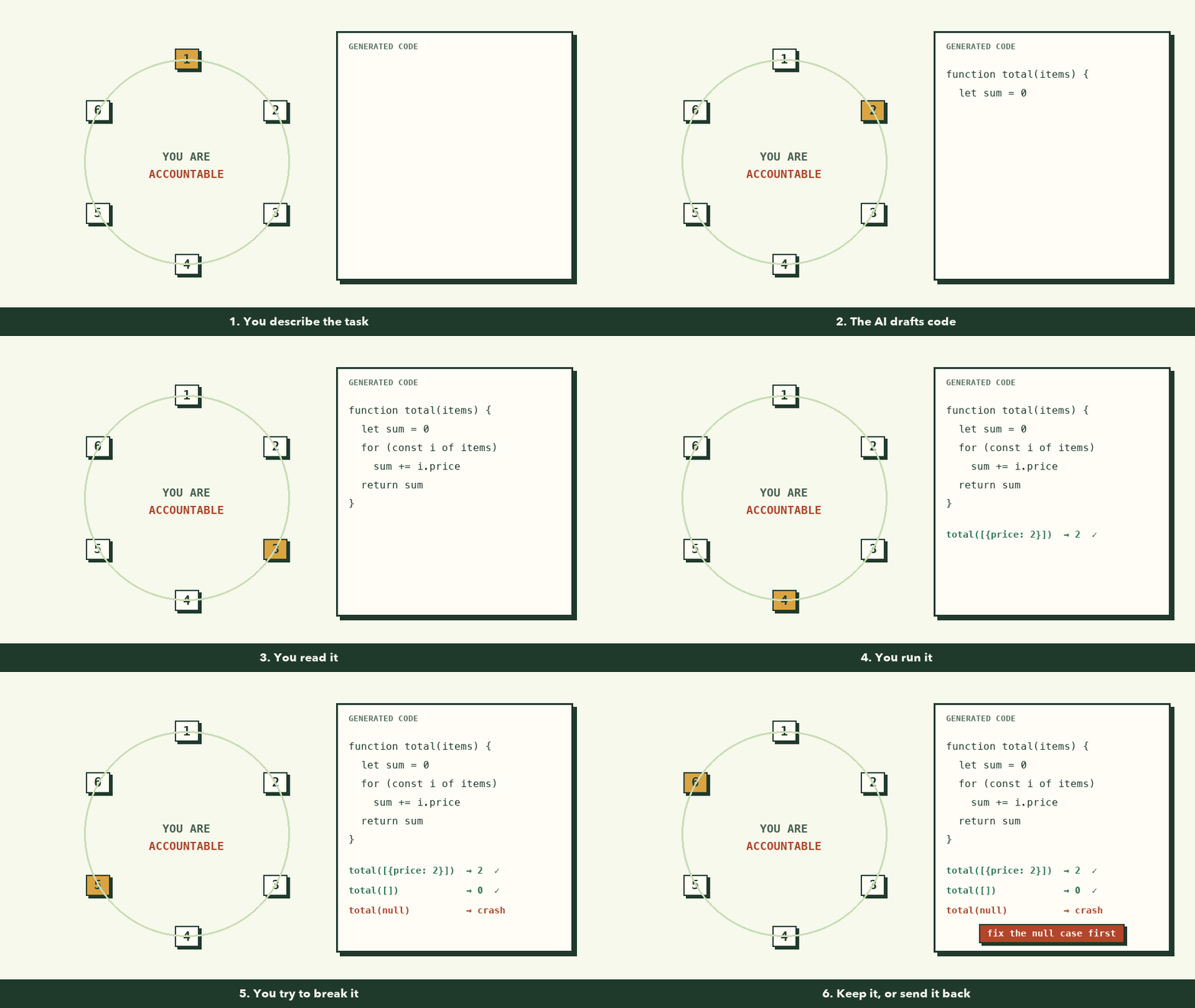
AI tools can write a first draft of code in seconds. That's genuinely useful. But a draft that looks right and code that is right are different things, and closing that gap is now a big part of the job.
Here's how common tasks change:
| Task | Without AI | With AI |
|---|---|---|
| Boilerplate | Write the first version yourself | Generate it, then read every line |
| Research | Search docs and examples | Ask for a direction, then confirm it in the real docs |
| Debugging | Trace logs and code paths | Let it suggest causes, then reproduce the bug yourself |
| Review | Review your teammates' code | Review generated code just as carefully |
The question isn't whether AI can write code. It's whether you can judge what it wrote:
- Does it solve the problem you actually have?
- What does it assume about the input?
- What happens when the network, a file, or a value isn't there?
- Is anything sensitive exposed?
- Could someone else maintain it next year?
AI extends what you can reach. You're still the one who's responsible for what ships.
Try it: give your learning a direction
You don't need to pick a specialty for life. You just need a direction for the next few weeks.
🎯 Hands-on Task (អនុវត្តផ្ទាល់)
- Grab a notebook or open a notes app.
- Answer three questions:
- What pulls you more right now: things people see, or the data and rules behind them?
- Pick one app you use every day. Which part of it do you most want to understand?
- What would you like to build first: a portfolio, a tool for a family business, something for a club?
- Choose one small project that fits your answers.
- Write one sentence about it that starts with "A user can…"
That sentence is your compass for the next lessons.
If you're stuck
- You can't choose frontend or backend. Build one tiny project that does both: a page that saves something and shows it again. It'll tell you which half you enjoy.
- You keep switching tools. Pick one stack and finish one small thing with it. The first goal is understanding how interface, server, and data connect, not finding the perfect framework.
- AI code looks right but doesn't work. Shrink the problem to one behavior, reproduce it, and check the inputs and outputs. Ask the tool to explain its assumptions, then check them against the code and the official docs.
What to remember
- Writing code is the visible part of the job, not the biggest part.
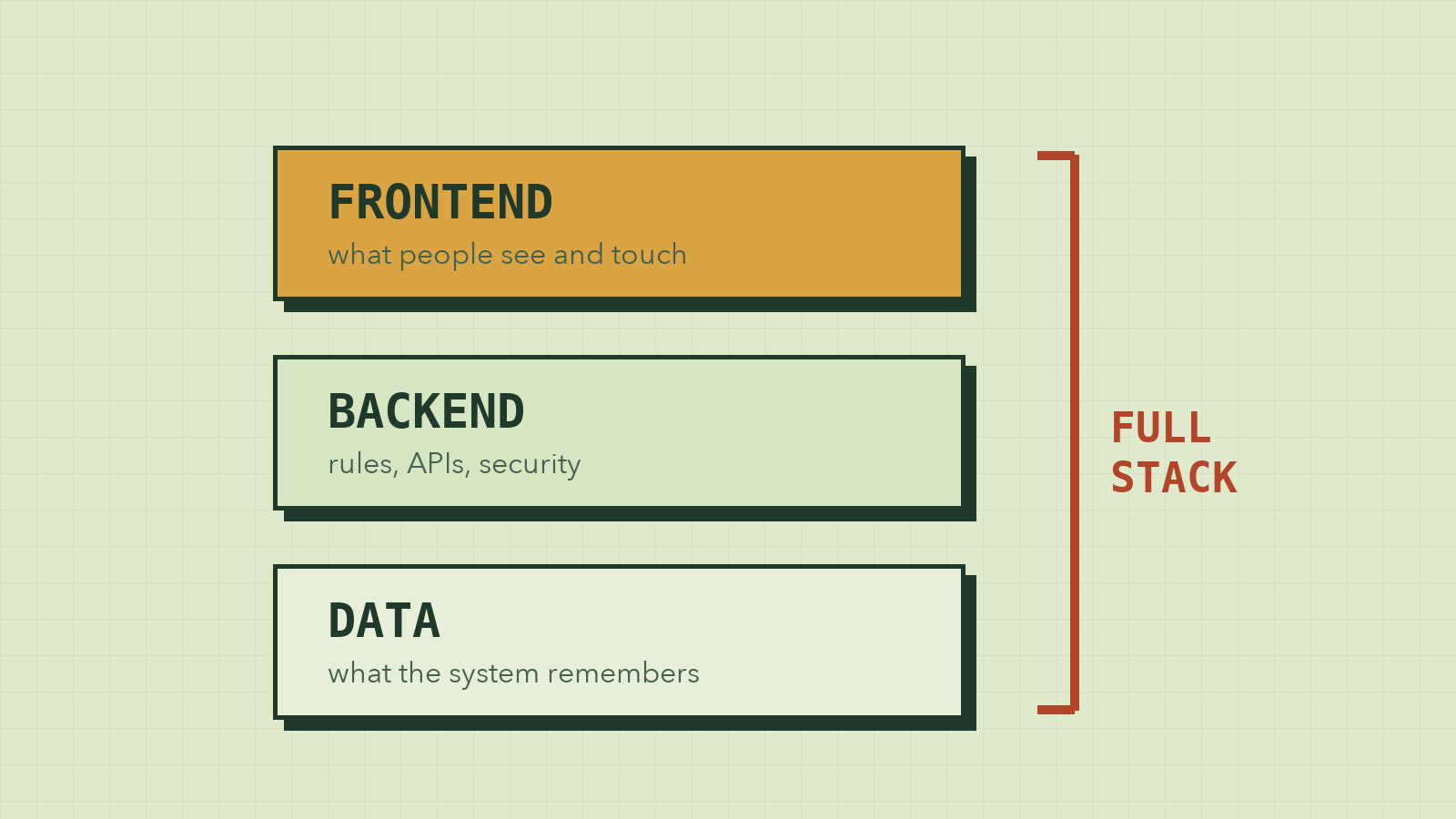
- Frontend is what people touch. Backend is the rules and the data. Full-stack follows a feature through both.
- AI writes drafts. Judging them is your job.
Next, you'll write your first real code: HTML: Build Your First Web Page.